JSTOR Global Plants Home
  • Home
  • Browse
  • About
  • Access
  • Account
    • Saved Items
    • Profile
  • Log in

Global Plants

Skip to Main Content
  • JSTOR Global Plants Home
  • Global Plants

    • Browse
    • About
    • Access
    • Account
      • Saved Items
      • Profile
Log in
  • Browse
  • About
  • Access
  • Account
    • Saved Items
    • Profile
Advanced Search

Compilation
Abutilon grantii

5 Images see all

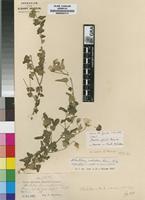
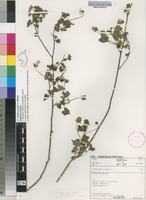
Isoparatype of Abutilon grantii A.Meeuse [family MALVACEAE]
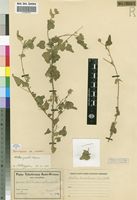
Paratype of Abutilon grantii Meeuse [family MALVACEAE]
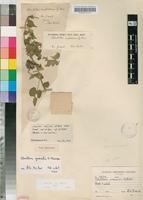
Isotype of Abutilon indicum sensu Harv. [family MALVACEAE]
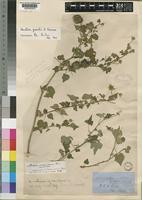
Abutilon grantii A.Meeuse [family MALVACEAE]
Filed as Abutilon grantii A.Meeuse [family MALVACEAE]
Previous
Next

Name

Identification
Abutilon sonneratianum (Cav.) Sweet [family MALVACEAE ] Verified by Not on sheet, Abutilon grantii Meeuse [family MALVACEAE ] (stored under name); Verified by [?], 1962
Related name
  • Abutilon indicum
  • Abutilon grantii
  • Abutilon sonneratianum

Flora

Entry for Abutilon grantii Meeuse [family MALVACEAE]
Herbarium
Royal Botanic Gardens, Kew (K)
Collection
Flora Zambesiaca
Resource Type
Reference Sources
Entry From
FZ, Vol 1, Part 2, page 420, (1961) Author: A. W. Exell
Names
Abutilon indicum [family MALVACEAE], sensu Harv. in Harv. & Sond., F.C. 1: 168 (1860). — Burtt Davy, F.P.F.T. 2: 275 (1932).
Abutilon grantii Meeuse [family MALVACEAE], sp. nov TAB. 93 fig. 9. Type from Natal, “Port Natal” (Durban), Grant (K, holotype; PRE).
Information
Perennial or biennial shrublet up to 1 (1–5) m. tall; stems slender, tough when young, somewhat angular or sulcate, soon terete, covered with a short stellate-tomentose, floccose or scabridulous but not velvety indumentum, sometimes somewhat glandular-viscid on the young parts, glabrescent, greyish usually turning brown to purplish-brown or almost black, ultimately woody and marked with longitudinal short shallow grooves. Leaf-lamina 1–4 (6) × 0·75–3 (5) cm., thin but firm, usually triangular-cordate with broadly rounded basal lobes and abruptly acuminate into a long narrowly-triangular acumen (often with lobules at the base of the acumen and the lamina thus appearing 3-lobed), sometimes ovate-cordate or cordate-triangular, margin varying from subentire or sinuous to ± crenate or bluntly and occasionally coarsely dentate, often discolorous but sometimes lower surface only slightly paler, upper surface dark greyish-green to brown, very shortly velutinous and smooth or with additional coarse stellate hairs, glabrescent, lower surface paler to almost ash-grey or white, velutinous; petiole slender, longer or shorter than the lamina, more or less densely stellate-pubescent, sometimes somewhat viscid and often with pilose hairs at the apex (if so, often also long hairs on veins near leaf-base on lower surface). Pedicels on main shoots, slender, generally much longer than the petioles and often exceeding the leaves, finely stellate-pubescent, articulated in upper 10 mm. Calyx grey-green, velutinous-tomentose; tube 3–4 mm. long and 6–7 mm. in diam. at the apex, cupuliform; lobes 5–7 × 3–4 mm., ovate- or oblong-elliptic to elliptic, subacute, minutely apiculate. Petals 11–13 mm. long, yellow, glabrous except at the base. Staminal tube stellate-hirsute. Fruit c. 12 × 18 mm., hemispherical, umbilicate-truncate, finely stellate-pubescent. Mericarps 10–20, 10–11 × 8–9 mm., much compressed, papery, 2–3-seeded, obliquely truncate to somewhat convex at the slanting apical side and produced at the outer angle into a sharp point or a subulate awn up to 3 mm. long. Seeds c. 2–5 × 2 mm., dark brown, minutely verrucose-papillose.
Habitat
rarely further inland. Lowland and coastal bush, in scrub, among herbaceous plants, in forest margins etc., sometimes close to the shore.
Altitude range
usually below 300 m.
300
0
inferred only top
Distribution
Mozambique M Matola, fl. & fr. 10.xii.1897, Schlechter 11688 (BM; BOL; GRA; K; L; PRE).
Distribution (external)
coastal regions of Natal
Eastern Cape Prov
Notes
The plants I refer to this species are variable in leaf-shape, the degree and colour of the pubescence, the presence or absence of viscid glands on young stems and petioles, and the presence or absence of long hairs at the apex of the petiole; but they agree in the characters of the calyx and the fruit (mericarps) and there are many intermediates between forms with discolorous leaves and non-discolorous leaves, densely pubescent and more glabrous plants, etc. An extreme form is the gathering Carvalho 257 (LM; PRE) which has a somewhat different “look”. I tentatively referred this specimen to A. grantii, but it may prove to require varietal status. More material is needed.

Related Materials

  • Terms and Conditions
  • Privacy Policy
  • Cookie Policy
  • Cookie Settings
  • Accessibility
  • Help
  • Contact Us
  • Facebook
  • Twitter
ITHAKA

JSTOR is part of ITHAKA, a not-for-profit organization helping the academic community use digital technologies to preserve the scholarly record and to advance research and teaching in sustainable ways.

©2000-2026 ITHAKA. All Rights Reserved. JSTOR®, the JSTOR logo, JPASS®, Aluka®, and ITHAKA® are registered trademarks of ITHAKA.

╳