JSTOR Global Plants Home
  • Home
  • Browse
  • About
  • Access
  • Account
    • Saved Items
    • Profile
  • Log in

Global Plants

Skip to Main Content
  • JSTOR Global Plants Home
  • Global Plants

    • Browse
    • About
    • Access
    • Account
      • Saved Items
      • Profile
Log in
  • Browse
  • About
  • Access
  • Account
    • Saved Items
    • Profile
Advanced Search

Compilation
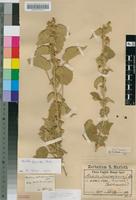
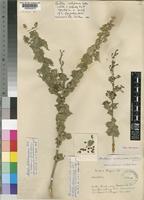
Abutilon betschuanicum

2 Images see all

Type of Abutilon betschuanicum Ulbr. [family MALVACEAE]
Abutilon messinicum Burtt Davy [family MALVACEAE]
Previous
Next

Name

Identification
Abutilon pycnodon Hochr. [family MALVACEAE ] Verified by Leistner, O., Abutilon messinicum Burtt Davy [family MALVACEAE ] (stored under name); Verified by Burtt Davy, J., Abutilon betschuanicum Ulbr. [family MALVACEAE ] Verified by Meeuse, A. D. J., Abutilon matopense Gibbs [family MALVACEAE ] Verified by Leistner, O.,
Related name
  • Abutilon pycnodon
  • Abutilon matopense
  • Abutilon messinicum
  • Abutilon betschuanicum

Flora

Entry for Abutilon matopense Gibbs [family MALVACEAE]
Herbarium
Royal Botanic Gardens, Kew (K)
Collection
Flora Zambesiaca
Resource Type
Reference Sources
Entry From
FZ, Vol 1, Part 2, page 420, (1961) Author: A. W. Exell
Names
Abutilon betschuanicum Ulbr. [family MALVACEAE], in Engl., Bot. Jahrb. 51: 15 (1913). Type from Cape Prov. (Kuruman).
Abutilon messinicum Burtt Davy [family MALVACEAE], F.P.F.T. 1: 36 (1926); op. cit. 2: 275 (1932). Type from the Transvaal (Messina).
Abutilon matopense Gibbs [family MALVACEAE], in Journ. Linn. Soc., Bot. 37: 431 (1902). — Eyles in Trans. Roy. Soc. S. Afr. 5: 413(1916). TAB. 93 fig. 7. Type: S. Rhodesia, Matopos, Gibbs 98 (BM, holotype; BOL).
Information
Perennial 0·75–2 m. tall, erect, much branched, shrubby, glaucous, usually densely leafy towards the tips of the branches, with an ash-grey (except on the leaves) appressed short velvety indumentum; stems herbaceous to wiry when young, usually with some longitudinally raised ridges decurrent from the leaf-bases or somewhat angular, later glabrescent and terete, ultimately woody and covered with a thin finely longitudinally fissured grey to brownish bark. Leaf-lamina 2–6 (10) × 4·5 (9) cm., thin but firm, glaucous or yellowish-glaucous above, slightly paler beneath, broadly ovate to ovate, apex shortly and usually bluntly acuminate, obtuse or acute (rarely rounded), margin usually rather coarsely crenate or crenate-serrate (occasionally crenulate to subentire), base cordate, venation on lower surface distinct and prominent; petiole 0·5–6 (12) cm. long, finely sulcate. Flowers yellow to apricot, solitary, one to few on short (6–8 cm. long) leafy axillary shoots; pedicels up to 5 cm. long, terete or in upper portion slightly angular, articulated at or above the middle. Calyx 7–9 mm. long, campanulate, incised to about the middle; lobes triangular-ovate, apiculate to acuminate, 1-nerved, finely ciliate. Petals 14–20 mm. long. Staminal tube hairy at the base. Fruit 14 mm. in diam., disk-shaped to depressed-hemispherical, nearly enclosed by the slightly accrescent calyx, umbilicate to truncate. Mericarps usually 18–24, 5–6 × 3–4·5 mm., blackish, shortly apiculate at the rounded apex, finely and somewhat floccosely stellate-tomentose dorsally and laterally in apical-dorsal region, 1-seeded. Seeds c. 2·5 × 1·5 mm., brown.
Habitat
Occurs mostly scattered, apparently never gregariously, on granite, norite and sandstone slopes in fairly exposed to rather shady situations, more rarely in riverine vegetation and in this habitat with larger and softer leaves.
Distribution
Zimbabwe S West Nicholson, fl. & fr. 23.iii.1953, Plowes 1575 (BM; PRE; SRGH); Beitbridge, E.M. & W. 448 (BM; LISC; SRGH).Zimbabwe W Bulalima-Mangwe, Feiertag in GHS 45372 (BM; SRGH); Matobo, fl. & fr. ii.1953, Miller 1588 (PRE; SRGH).
Distribution (external)
Transvaal
Cape Prov. (Griqualand-W.)
Notes
The seeds vary from quite glabrous and smooth to finely white-punctate or sometimes minutely stellate-lepidote.

Related Materials

  • Terms and Conditions
  • Privacy Policy
  • Cookie Policy
  • Cookie Settings
  • Accessibility
  • Help
  • Contact Us
  • Facebook
  • Twitter
ITHAKA

JSTOR is part of ITHAKA, a not-for-profit organization helping the academic community use digital technologies to preserve the scholarly record and to advance research and teaching in sustainable ways.

©2000-2026 ITHAKA. All Rights Reserved. JSTOR®, the JSTOR logo, JPASS®, Aluka®, and ITHAKA® are registered trademarks of ITHAKA.

╳