JSTOR Global Plants Home
  • Home
  • Browse
  • About
  • Access
  • Account
    • Saved Items
    • Profile
  • Log in

Global Plants

Skip to Main Content
  • JSTOR Global Plants Home
  • Global Plants

    • Browse
    • About
    • Access
    • Account
      • Saved Items
      • Profile
Log in
  • Browse
  • About
  • Access
  • Account
    • Saved Items
    • Profile
Advanced Search

Compilation
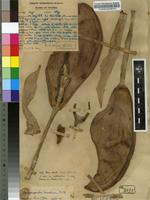
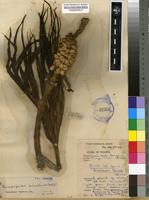
Amorphophallus dracontioides

2 Images see all

Filed as Amorphophallus dracontioides N.E.Br. [family ARACEAE]
Previous
Next

Name

Identification
Amorphophallus dracontioides N.E.Br. [family ARACEAE ] (stored under name); Verified by Keay, R.W.J., 1950
Related name
  • Amorphophallus dracontioides
Common name
  • tùtúgéy (LB) (NIGERIA, BEROM), Burkill, H.M. 1985. The useful plants of west tropical Africa, Vol. 1
  • akufọdẹwa (JMD) (NIGERIA, YORUBA), Burkill, H.M. 1985. The useful plants of west tropical Africa, Vol. 1
  • , kinciya (ZOG) bùrár jaakii = donkey’s penis (JMD) bùrár kùree = penis of the dog (ZOG) gwáázán kwaađóó (LB) gwaázar-giiwaá (ZOG) gwazar giwa = elephant’s coco-yam hántsàr giíwaá = elephant’s udder (JMD; ZOG) kinchiya kunnan jạki, kunnen jaakii = ears of the donkey, from the shape of the leaf (ZOG) (NIGERIA, HAUSA), Burkill, H.M. 1985. The useful plants of west tropical Africa, Vol. 1
  • gunta (JRA) (NIGERIA, ARABIC-SHUWA), Burkill, H.M. 1985. The useful plants of west tropical Africa, Vol. 1
  • èré ótóró = female otoro (KW) (NIGERIA, IJO), Burkill, H.M. 1985. The useful plants of west tropical Africa, Vol. 1
  • dragon’s football (Morton)., Burkill, H.M. 1985. The useful plants of west tropical Africa, Vol. 1

Flora

Entry for AMORPHOPHALLUS dracontioides N. E. Br. [family ARACEAE]
Herbarium
Royal Botanic Gardens, Kew (K)
Collection
Flora of Tropical Africa
Resource Type
Reference Sources
Entry From
Flora of Tropical Africa, Vol 8, page 137, (1902) Author: (By N. E. Brown.)
Names
AMORPHOPHALLUS dracontioides N. E. Br. [family ARACEAE]
Hydrosme dracontioides Engl. [family ARACEAE], Jahrb. xv. 461, t. 18; Durand & Schinz, Consp. Fl. Afr. v. 473; Engl. & Prantl, Pflanzenfam. Nachträge zu ii.–iv. 59.
Information
Tuber “large, flattened” (Barter), “as large as a child's head” (Johnson), “as large as a Cheshire cheese” (Irving). Leaves 5 ft. high (Johnson), “18 in. high, finely cut” (Barter); petiole smooth; segments 3–10 in. long, 2 1/2–7 lin. broad, linear or linear-lanceolate, tapering to a fine point, decurrent. Peduncle 2/3–2 ft. long, green suffused with purple, and spotted with blackish-purple, smooth. Spathe 7–13 in. or more long, 3–8 in. diam., convolute for half its length, cylindric or campanulate at the base, then dilating into an ovoid cucullate upper part, with an oblique ovate mouth in front, glabrous within and without, dull purple, striped with darker purple and spotted with whitish, or light green mottled with brown on the outside, shading into a bluish-flesh tint or whitish at the base, inside rich dark velvety-purple in the upper part, and striped with white and purple-red in the tube. Spadix not exceeding the convolute part of the spathe, stipitate; stipes 1/3– 1/2 in. long, cylindric; flowering part dense, female 1/3– 3/4 in. long, cylindric, male 1–1 3/4 in. long, stout, obconic; appendix 2–4 in. long, 1–3 1/2 in. thick, ovoid, obtuse, blackish-purple or yellowish-green, rugose. Ovary ovoid, 1-celled, green; style 1–1 1/3 lin. long, jointed near the middle; stigma small, discoid or cushion-like. Anthers very crowded, pale brownish-green.
Distribution
Gold Coast Upper Guinea Kpong, on the Volta River, Johnson, 662!Togoland Upper Guinea in bush by the River Angar in Anyanga district, near Bismarkburg, Büttner, 419 (ex Engler).Lagos Upper Guinea Abeokuta (drawing), Irving! and at Illaro, Millen, 125 of 1893 collection!Niger Upper Guinea Nupe, in moist ground, Barter, 1141!
Notes
The leaf with Barter's specimen is only a foot high, evidently from a juvenile plant. The spathe in Dr. Irving's drawing is 13 in. long, and he states that it is “a small specimen to fit the paper, generally 3 times larger.” I can see no difference between the specimens collected by Barter and Johnson, and Dr. Irving's drawing, except as to size. This plant was referred by Schott to Corynophallus Afzelii (A. leonensis), but the ovoid, cucullate limb of the spathe at once distinguishes it from that species. The figure given by Engler appears to be that of an immature (unopened) spathe viewed sideways.

Related Materials

  • Terms and Conditions
  • Privacy Policy
  • Cookie Policy
  • Cookie Settings
  • Accessibility
  • Help
  • Contact Us
  • Facebook
  • Twitter
ITHAKA

JSTOR is part of ITHAKA, a not-for-profit organization helping the academic community use digital technologies to preserve the scholarly record and to advance research and teaching in sustainable ways.

©2000-2026 ITHAKA. All Rights Reserved. JSTOR®, the JSTOR logo, JPASS®, Aluka®, and ITHAKA® are registered trademarks of ITHAKA.

╳