JSTOR Global Plants Home
  • Home
  • Browse
  • About
  • Access
  • Account
    • Saved Items
    • Profile
  • Log in

Global Plants

Skip to Main Content
  • JSTOR Global Plants Home
  • Global Plants

    • Browse
    • About
    • Access
    • Account
      • Saved Items
      • Profile
Log in
  • Browse
  • About
  • Access
  • Account
    • Saved Items
    • Profile
Advanced Search

Compilation
Adenia goetzei

2 Images see all

Filed as Adenia goetzei Harms [family PASSIFLORACEAE]
Previous
Next

Name

Identification
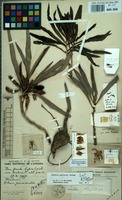
Adenia goetzei Harms [family PASSIFLORACEAE ] (stored under name); Verified by Not on sheet,
Related name
  • Adenia goetzei

Flora

Entry for ADENIA goetzei Harms [family PASSIFLORACEAE]
Herbarium
Royal Botanic Gardens, Kew (K)
Collection
Flora of Tropical East Africa
Resource Type
Reference Sources
Entry From
Flora of Tropical East Africa, page 1, (1975) Author: W. J. J. O. de Wildem (Rijksherbarium, Leiden)
Names
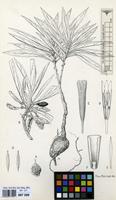
ADENIA goetzei Harms [family PASSIFLORACEAE], in E.J. 30 : 360, t. 14 (1902); Engl., V.E. 3(2); 603 (1921); Harms in E. & P. Pf., ed. 2, 21 : 491 (1925); de Wilde in Meded. Landbouwhogeschool Wageningen 71–18 : 200 (1971). Type : Tanzania, Mbeya District, Toola, Goetze 1418 (B, holo.†)
Information
Erect unbranched or sparingly branched herb up to 35 cm., without tendrils, glabrous, growing from a tuber. Leaf-blades somewhat glaucous, purple-brown spotted beneath, oblong-lanceolate to lanceolate-linear, base ± long-attenuate and inconspicuously auricled, top acute, 7–22 by (0.5–)1– 6.5 cm., ± pinninerved; margin entire; petiole (0–)1–2(–4) mm. Glands at blade-base 2, partly situated on 2 ± inward curved auricles at the very base of the blade; blade-glands 0–20, scattered. Stipules narrowly triangular, entire or 2–5-dentate or -partite, 1–2.5 mm. Inflorescences sessile or up to 1 cm. peduncled, 1–5-flowered, the lower often axillary to 5–10 mm. long tricuspidate cataphylls; tendrils 0. Flowers polygamous. Male flowers resembling hermaphrodite flowers. Hermaphrodite flowers tubular-infundibuliform, including the 2.5–8 mm. long stipe 12–26 mm.; hypanthium (0.5–)1–3 mm.; calyx-tube 4–8(–10) by 3–8 mm., lobes oblong, obtuse 3–8(–9) mm., crispate-fimbriate; petals lanceolate-linear, acute, 5–12 mm., 1–3-nerved, fimbriate, inserted at the same level as or up to 3 mm. above the corona; filaments 3–7 mm., free or up to 2 mm. connate, inserted at the base of the hypanthium or on a short androgynophore; anthers 2.5–5 mm., sometimes abortive towards the top, provided with an up to 1 mm. long, mostly ± papillate apiculum; septa (0–)1–3 mm. high; corona hairs 1–2 mm.; disk glands ±0.5 mm.; ovary in ♂ flowers vestigial; gynophore 2(–4) mm.; ovary ellipsoid-oblong, 3.5–5(–6) mm.; styles free or connate up to 1 mm., free style arms 1–1.5 mm.; stigmas subglobose, papillate, each 1–1.5 mm. in diameter. Female flowers resembling ♂ and hermaphrodite flowers, including the 2.5–5.5 mm. long stipe 16–22 mm.; petals 5–7 mm.; staminodes ± 2 mm.; septa 0–1 mm. high. Fruits 1 per inflorescence, pendent at maturity, ellipsoid to obovoid, excluding the curved 10–20 mm. long gynophore 3–4(–5) by 2–2.5 cm.; pericarp coriaceous. Seeds 30–40 per capsule, ovoid to subglobose, 4–4.5 mm.
Range
DISTR. T4, 7, 8
Altitude range
900–1300 m.
Distribution
TANZANIA Kigoma District 64 km. Ikola-Ulemba, 6 Nov. 1959, Richards 11723 ! & 11726 !TANZANIA Songea District Songea Airfield, 1 Jan. 1956, Milne-Redhead & Taylor 7999 ! & Kwamponjore Valley, 7 Feb. 1956, Milne-Redhead & Taylor 7999B !
Distribution (external)
Zaire
Zambia
Rhodesia
Notes
This species is usually polygamous. The flowers are variable in size and shape; relatively broad as well as narrow male flowers may be found on a single plant.

Related Materials

  • Terms and Conditions
  • Privacy Policy
  • Cookie Policy
  • Cookie Settings
  • Accessibility
  • Help
  • Contact Us
  • Facebook
  • Twitter
ITHAKA

JSTOR is part of ITHAKA, a not-for-profit organization helping the academic community use digital technologies to preserve the scholarly record and to advance research and teaching in sustainable ways.

©2000-2026 ITHAKA. All Rights Reserved. JSTOR®, the JSTOR logo, JPASS®, Aluka®, and ITHAKA® are registered trademarks of ITHAKA.

╳