

Search Results
Results 1 - 8 of 8
Page 1 of 1
Previous
Next
![Type of Walleria hockii De Wild. [family TECOPHILAEACEAE]](/fsi/img/size1/alukaplant/br/phase_01/br0009/br0000008642639.jpg)
Type of Walleria hockii De Wild. [family TECOPHILAEACEAE]
Hock A., #S.N.
1911-01-01
Specimens
Unknown
Type of Walleria hockii De Wild. [family TECOPHILAEACEAE]
Walleria nutans Kirk [family TECOPHILAEACEAE] (stored under name); Verified by Carter S., 1961/04/12
Walleria nutans Kirk [family TECOPHILAEACEAE] (stored under name); Verified by Carter S., 1961/04/12
![Holotype of Walleria muricata N.E.Br. [family TECOPHILAEACEAE]](/fsi/img/size1/alukaplant/k/phase_01/k0000/k000256020.jpg)
Holotype of Walleria muricata N.E.Br. [family TECOPHILAEACEAE]
Lugard, #289
01-1898
Specimens
Botswana
Walleria nutans Kirk [family TECOPHILAEACEAE] (stored under name); Verified by S.Carter,
Holotype of Walleria muricata N.E.Br. [family TECOPHILAEACEAE]; Verified by N.E.Brown
Holotype of Walleria muricata N.E.Br. [family TECOPHILAEACEAE]; Verified by N.E.Brown
![Syntype of Walleria nutans Kirk [family TECOPHILAEACEAE]](/fsi/img/size1/alukaplant/k/phase_01/k0008/k000256018.jpg)
Syntype of Walleria nutans Kirk [family TECOPHILAEACEAE]
Waller, #s.n.
1864
Specimens
Malawi
Syntype of Walleria nutans Kirk [family TECOPHILAEACEAE] (stored under name); Verified by Unknown
![Syntype of Walleria nutans J.Kirk [family TECOPHILAEACEAE]](/fsi/img/size1/alukaplant/k/phase_01/k0009/k000256019.jpg)
Syntype of Walleria nutans J.Kirk [family TECOPHILAEACEAE]
Waller, #s.n.
None
Specimens
Malawi
Syntype of Walleria nutans J.Kirk [family TECOPHILAEACEAE] (stored under name)
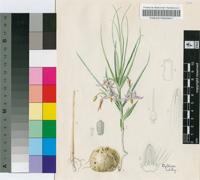
![WALLERIA nutans Kirk [family TECOPHILAEACEAE]](/fsi/img/misc/plants/static_thumbs/flora_capensis_icon96.jpg)
WALLERIA nutans Kirk [family TECOPHILAEACEAE]
Flora Capensis, page 253, (1897) Author: (By J. G. BAKER).
Royal Botanic Gardens, Kew (K)
Reference Sources
stem slender, 1/2–1 1/2 ft. long, decumbent at the base; leaves of the lower half of the stem small, rudimentary, of the upper half linear, sessile, alternate, ascending, 3–4 in. long; pedicels ascending, 1–2 in. long, cernuous at the apex, furnished with 1–2 linear foliaceous bracts; perianth with a greenish campanulate tube 1/6 in. long; segments lanceolate, acute, patent, 1/2 in. long, laxly 5–7-nerved; anthers more than half as long as the perianth-segments. null
![WALLERIA nutans Kirk [family TECOPHILAEACEAE]](/fsi/img/misc/plants/static_thumbs/Flora_of_tropical_Africa_icon96.jpg)
WALLERIA nutans Kirk [family TECOPHILAEACEAE]
Flora of Tropical Africa, Vol 7, page 421, (1898) Author: (By J. G. Baker.)
Royal Botanic Gardens, Kew (K)
Reference Sources
Differs only from the other species by its linear leaves and cernuous pedicels.
![Walleria nutans J. Kirk [family TECOPHILAEACEAE]](/fsi/img/misc/plants/static_thumbs/flora_zambesiaca_icon96.jpg)
Walleria nutans J. Kirk [family TECOPHILAEACEAE]
FZ, Vol 12, Part 3, page 18, (2001) Author: E. J. Cowley & R. K. Brummit
Royal Botanic Gardens, Kew (K)
Reference Sources
Erect perennial herb (4)10–30 cm tall. Tubers 1–5, subspherical, 1.7-2.5 × 2-3 cm, up to c. 20 cm below ground on a slender vertical underground stem. Stem leafy, simple or sometimes with up to 3 branches from axils of the lower leaves, ± flexuous, ± strongly longitudinally ribbed at least above, glabrous, scabrid, or with scattered short recurved prickles. Leaves cauline, becoming progressively larger and congested towards the stem apex, sessile, (2)7-17 × 0.2-1 cm, linear to linear-lanceolate, acute or ± gradually tapering to the apex, occasionally slightly cirrose at the tip, with recurved prickles 0.75–c. 1 mm long on the midvein beneath and/or on the leaf margin, or prickles absent; lowermost leaves 0.7-1.2 cm long, membranous. Peduncles 2-5 cm long, ascending, smooth, scabrid or with minute prickles; bracts 5-17 × 0.5-2.5 mm; pedicels deflexed. Tepalspure white to pink, mauve, purple or blue, spreading, 6-15 × 2-5 mm, ovate, acute, 5-7-veined, free to the base, ± recurved at the tips, outer segments slightly longer than the inner. Filaments 0.5-1 mm long. Anthers 4-8 × 0.75 mm, yellow with blue to purple tips, connivent and adherent at the apex; pores lateral at the anther apex, introrse, oblique. Style 7-8.5 mm long, shorter than, or slightlyexserted from the perianth segments. Capsulegreen, yellow or orange,8-17 mm in diameter, globose, slightly rugose, surrounded by the persistent perianth segments. Immature seeds 2 × 1 mm.
Page 1 of 1
Previous
Next