

Search Results
Results 1 - 14 of 14
Page 1 of 1
Previous
Next
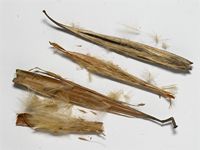
![Filed as Strophanthus kombe Oliv. [family APOCYNACEAE]](/fsi/img/size1/alukaplant/nu/phase_01/nu0006/nu0019286-0.jpg)
Filed as Strophanthus kombe Oliv. [family APOCYNACEAE]
Wirminghaus, J.O., #1239
1992-12-19
Specimens
Zimbabwe
Strophanthus kombe Oliv. [family APOCYNACEAE] (stored under name); Verified by J.O.W
![Holotype of Strophanthus kombe Oliv. [family APOCYNACEAE]](/fsi/img/size1/alukaplant/k/phase_01/k0006/k000233786.jpg)
Holotype of Strophanthus kombe Oliv. [family APOCYNACEAE]
Meller, C.J., #s.n.
11-1861
Specimens
Malawi
Holotype of Strophanthus kombe Oliv. [family APOCYNACEAE] (stored under name); Verified by Beentje, H.J.,
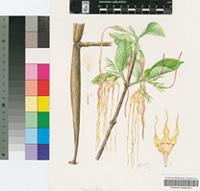
![Filed as Strophanthus kombe Oliv. [family APOCYNACEAE]](/fsi/img/size1/alukaplant/nu/phase_01/nu0007/nu0019287-0.jpg)
Filed as Strophanthus kombe Oliv. [family APOCYNACEAE]
Raymond, R.E., #191
1973-11-03
Specimens
Zimbabwe
Strophanthus kombe Oliv. [family APOCYNACEAE] (stored under name)

Note by Mr. J. Medley Wood; from the Botanic Gardens Durban, South Africa; 10 Aug 1887; two page note comprising one image; folio 1762.
Medley Wood, John
Letters (Correspondence)
![STROPHANTHUS kombe Oliv. [family APOCYNACEAE]](/fsi/img/misc/plants/static_thumbs/flora_tropEA_icon96.jpg)
STROPHANTHUS kombe Oliv. [family APOCYNACEAE]
Flora of Tropical East Africa, page 1, (2002) Author: E.A. OMINO
Royal Botanic Gardens, Kew (K)
Reference Sources
DISTR. K 7; T 3, 6, 8
Sarmentose shrub 1–3.5 m high or liana to 20 m long, deciduous, flowers appearing with the leaves, trunk to 10 cm in diameter, bark reddish brown or grey-brown; branches scabrid; branchlets densely hispid; latex clear, white or yellow. Leaves opposite; blade often convex, ovate or elliptic, 8–24 cm long, 5–17 cm wide, base cuneate, rounded or subcordate, apex obtuse, acute or acuminate, densely hispid on both surfaces but glabrescent above; petiole 1–5 mm long. Inflorescence 1–12-flowered, pedunculate, fairly congested, densely hispid in all parts; pedicels 3–20 mm long. Flowers fragrant; sepals narrowly ovate or linear, 9–27 mm long, acute; corolla white turning yellow, red-spotted inside; corolla tube 13–24 mm long, corolla lobes ovate, 3–16 mm long, 4–9 mm wide, narrowing into the 9–20 cm long pendulous tails, corona lobes 1–3 mm long. Fruit hard, the mericarps opposite-divergent, cylindrical or nearly so, 15–47 cm long, 1–2.6 cm in diameter, tapering to a knob, lenticellate, hispid and glabrescent; seeds 11–21 mm long, densely pubescent, with a stalked coma 6–14 cm long.
![Memorandum from Mr. Daniel Oliver; from the Royal Botanic Gardens, Kew; 20 Nov[?] 1887; one page memorandum comprising one image; folio 1763.](/fsi/img/size1/alukaplant/k/phase_01/k0001/kadc4571_001.jpg)
Memorandum from Mr. Daniel Oliver; from the Royal Botanic Gardens, Kew; 20 Nov[?] 1887; one page memorandum comprising one image; folio 1763.
Oliver, Daniel
Letters (Correspondence)
![Strophanthus kombe [family APOCYNACEAE]](/fsi/img/misc/plants/static_thumbs/cover_florasa_icon96.jpg)
Strophanthus kombe [family APOCYNACEAE]
Flora of South Africa, (2003) Author: Dr J.P. Roux
South African National Biodiversity Institute, Compton Herbarium, Cape Town (SAM)
Reference Sources
Found in dry, lowveld woodland, often on rocky situations in north-eastern Transvaal, extending into Mozambique and the Rhodesias to Tanganyika.
Shrub or woody climber; stems hispid-tomentose when young, becoming glabrescent and scabrid with age; bark grey or black, dotted with lenticels; Leaves subsessile, elliptic to broadly elliptic or ovate-elliptic, 8-16 cm long and 4-5-10 cm broad, obtuse at the base, apex rounded to abruptly acute or apiculate, densely hispid-tomentose when young, glabrescent and scabrid above when mature, drying dark brownish above, paler below; secondary nerves 7-10 on each side, oblique, distinct below; petiole 0-5 mm long, channelled above; axillary glands present. Inflorescence cymose, compact, 1—several-flowered, terminal on short branches, appearing together with or before the leaves, hispid; peduncles short; bracts narrowly lanceolate, 6 mm long; pedicels slender, 7-10 mm long. Flowers cream to yellowish with red or purple markings, scented. Calyx hispid-tomentose, 10-14 mm long; sepals linear-lanceolate. Corolla pubescent without; tube narrowly cylindric at the base for 7-9 mm then campanulate-infundibuliform for 7-10 mm; lobes produced into long, slender, pendulous appendages, 6-12 cm long; throat scales very short, densely papillose. Stamens included, subsessile; anthers lanceolate, acuminate, sagittate, 4-5 mm long, polliniferous in the upper half, shortly apiculate. Ovary of 2 free carpels, densely tomentose; style filiform, 10-12 mm long; stigma enclosed by the anthers, capitate, with a reflexed frill at the base. Fruit of 2 follicular mericarps eventually spreading at 180°; follicles 20-40 cm long and 2-3-5 cm broad at the base, tapering gradually to 5-8 mm and then abruptly expanding to 10-14 mm at the apex, brown, glabrous, longitudinally striate and markedly lenticellate. Seeds lanceolate-oblong, 14-16 mm long, tomentose, light brown; awn plumose, 10-15 cm long, with a naked stalk 3-4 cm long; cotyledons oblong; endosperm scanty.

Letter from John Donnell Smith to Sir William Thiselton-Dyer; from 505 Park Avenue, Baltimore, MD, USA; 26 Oct 1902; two page letter comprising one image; folio 224
Donnell Smith, John
Letters (Correspondence)
![Isotype of Trichaulax mwasumbii Vollesen [family ACANTHACEAE]](/fsi/img/size1/alukaplant/c/phase_01/c0000/c10000060.jpg)
Isotype of Trichaulax mwasumbii Vollesen [family ACANTHACEAE]
Mwasumbi, L.B., #14238
1989-01-19
Specimens
Tanzania
Isotype of Trichaulax mwasumbii Vollesen [family ACANTHACEAE] (stored under name)
![Strophanthus kombe Oliver [family APOCYNACEAE]](/fsi/img/misc/plants/static_thumbs/flora_zambesiaca_icon96.jpg)
Strophanthus kombe Oliver [family APOCYNACEAE]
FZ, Vol 7, Part 2, (1985) Author: A. J. M. Leeuwenberg and F. K. Kupicha et al.
Royal Botanic Gardens, Kew (K)
Reference Sources
Sarmentose shrub, 1–3·5 m. high, or liana, 2·5–20 m. high, deciduous, flowers and leaves appearing at the same time; latex clear, white, or yellow. Roots thick and fleshy. Trunk up to 10 cm. in diam.; bark reddish-brown or grey-brown; branches scabrous as the result of persistent hair-bases; branchlets densely hispid. Leaves petiolate; petiole 1·5–5 mm. long; lamina dark green, paler beneath, ovate or elliptic, less often obovate or nearly circular, 1·1–2·3 times as long as wide, in mature leaves 8–23·5 x 5–16·5 cm. cuneate, rounded, or subcordate at the base, obtuse, acute, or acuminate at the apex (acumen 1–11 mm. long), papyraceous or chartaceous, in young leaves densely hispid on both sides, in older leaves glabrescent above, with 7–13 pairs of secondary veins; tertiary venation conspicuous beneath. Inflorescence 1–12-flowered, pedunculate, fairly congested, densely hispid in all parts; pedicels 3–14(20) mm. long; bracts sepal-like. Flowers fragrant. Sepals subequal, narrowly ovate or linear, 9–20(27) x 1·5–3·5 mm., acute, densely hispid. Corolla tube 13–24 mm. long and widening at almost 1/2-2/3 of its length into a cyathiform upper part, at the mouth (6)8–14 mm. wide, densely hispidulous outside except for the base, sparsely hispidulous inside except for the base; corona lobes Ungulate, 1–3 x 1–2·4 mm., minutely puberulous or papillose; corolla lobes ovate, 3–16 x 4–8·5 mm., gradually or fairly abruptly narrowing into the pendulous tails; lobes (including the tails) 100–160(–200) mm. long, puberulous except for the inner side of the tails. Stamens included for 2·7–7·3 mm.; filaments curved, 0·6–1·2(2) mm. high; anthers 3·7–6·2 x 0·6–1·1 mm., glabrous; acumen 0·1–0·5 mm. long. Ovary 0·8–1·7 x 1·5–2·3 mm., densely hispid with long erect hairs, sometimes glabrous at the base; style 6·5–13·5 mm. long; clavuncula 1–1·8 x 0·9–1·3 mm.; stigma minute. Follicles divergent at an angle of 180°, long tapering toward the apex and ending in a small or large knob, rarely without knob and then with an obtuse apex, 15–47 cm. long and 1·3–2·6 cm. in diam.; exocarp thick and hard, densely hispid or pubescent in young fruits and glabrescent when maturing, especially on the adaxial side densely lenticellate. Seeds with the grain 11–21 x 2·5–4·5 x 1·5 mm., densely pubescent; rostrum glabrous for 20–57 mm. and bearing a coma for 20–42 mm.; coma 42–80 mm. long.
![Strophanthus hispidus DC. [family APOCYNACEAE]](/fsi/img/misc/plants/static_thumbs/rt_upwta.png)
Strophanthus hispidus DC. [family APOCYNACEAE]
Burkill, H.M. 1985. The useful plants of west tropical Africa, Vol 1
Royal Botanic Gardens, Kew (K)
Reference Sources
None
Strophanthus sarmentosus DC. [family APOCYNACEAE]
Burkill, H.M. 1985. The useful plants of west tropical Africa, Vol 1
Royal Botanic Gardens, Kew (K)
Reference Sources
None
Page 1 of 1
Previous
Next
Narrow by:
- Resource Type
- Geography
- Collection
-
- Economic Botany Collection, Kew (1)
- Flora Zambesiaca (1)
- Flora of Southern Africa (1)
- Flora of Tropical East Africa (1)
- Herbarium Specimens (4)
- Royal Botanic Gardens, Kew: Archives: Directors' Correspondence (3)
- SANBI, Pretoria National Herbarium (Artwork) (1)
- Useful Plants of West Tropical Africa (2)